
Light in the Darkness- Midwinter Proposals, Ceremonies and Festivities
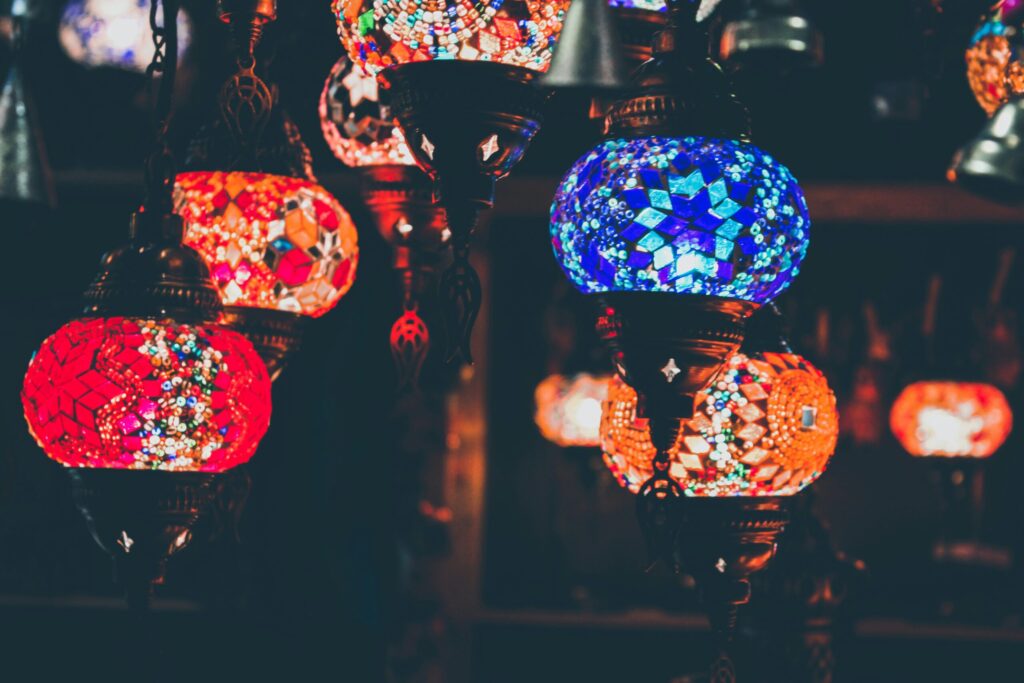
”People are like stained-glass windows. They sparkle and shine when the sun is out, but when the darkness sets in, their true beauty is revealed only if there is a light from within. Elisabeth Kübler-Ross
On Relationships at Midwinter
Across the northern hemisphere, we are woven together by the ways that we seek light in the darkness at this time of year. Between the darkest months of November and February is when most marriage proposals take place, with a peak around Christmas and New Year. Committing to be with one another brings warmth, joy, hope and excitement, and weddings become projects to dream about and spur us on during the bleakest months.
I have witnessed some beautiful proposals at this time of year amongst family members. My sister-in-law proposed on new year’s eve three years ago, and got married 9 months later with a hand-tying ritual that I performed for the couple. Two years ago my partner’s cousin was in hospital after a near-fatal car crash. Just after Christmas, she turned a corner and slowly slowly began regaining movement and the ability to communicate. At this point, she proposed to her partner. Wearing the engagement ring on her hand brought joy, hope and determination. 18 months later, watching them betroth and dance their nuptial dance was life-affirming.

As we seek cosiness and wish to be amongst our loved ones, it is often a time when we most miss those we can’t be with or grieve relationships we never had or relationships that have ended. For many people, this is a time of loneliness and sorrow. The poet Kahlil Gibran describes joy and sorrow as inseparable- our laughter and our tears come from the same well inside us. He says that our joy often reflects what we once yearned sorrowfully for, and our sorrow reflects what was once our delight.
Midwinter work of a Celebrant
This midwinter I was preparing a parting of ways ceremony- holding space for two friends to mark the end of their partnership in a way that allows for grief and gratitude, and acknowledgement of all the joy, and pain, and most significantly, the growth that came from their time together. The way they are doing this is an inspiration to me and it’s an honour to be part of their process.
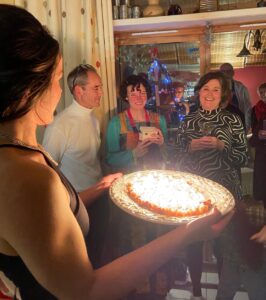
In parallel, I was preparing an Appreciation Ritual for my parents-in law to offer them at their joint 60th birthday party. I melted beeswax into 60 star-shaped candles which we presented them along with a treasure chest of appreciative messages from many of the people they bring light to.
Festivals of Light in the Darkness
Like Joy and Sorrow, Light and Darkness are in co-existence at this time of year – we focus on the return of the light when the earth’s poles are furthest from it. Midwinter is perhaps one of the oldest festival periods of humankind. We are still discovering archaeological evidence and making sense of Neolithic monuments that align with the winter solstice, and rituals that took place at this time up to 10,000 years ago. The return or rebirth of the sun was not to be taken for granted. There is a strong cultural and spiritual magnetism at this time of year and it is no surprise that different religions and cultures have chosen to celebrate the birth of their sun gods or divine light in the world at this time of year and so many secular traditions involving celebrations of light have evolved.
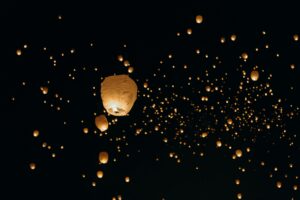
Buddhists, Christians, Druids, Jains, Jews, Pagans and Sikhs alike all hold a celebration involving lights and candles, honouring of the divine, cleansing, gifting, feasting and family, and some form of letting go, inviting in, liberation or rebirth. We find light festivals where lanterns are released into the sky, or floated in water. Flames are carried in procession or solemnly blown out and reignited, and homes, trees and buildings are illuminated. Just some examples are the Lantern Festival at the start of Chinese New Year, or the Nordic Lucia procession, La Krathong in Thailand or the Japanese illuminations.
12 days of celebration…and reflection
In the Roman calendar, there were three different festivals between the Solstice and the New Year– Saturnalia (in celebration of Saturn, the god of harvest and farming); Sol Invictus – a festival to celebrate the ‘unconquered’ god of the sun, and Kalendae on the 1st of January to celebrate the new calendar year. To this day, many of us are still rushing around celebrating with different configurations of friends and family across these days, feeling a bit too busy when we feel like resting, and needing an extension to the holiday-period into January. The significance of these days links to the lunar and solar calendars:
The 21st of December is the beginning of a period of 12 ‘intercalary’ days – the extra days inserted into the Gregorian version of the calendar to make it correspond with the length of a solar year. Without them, we would be following a lunar calendar which is 12-13 days shorter. They can be seen as liminal, magical days, and days to look inwards or walk in nature and read signs for the coming year. In Wales and Brittany, these days are called the Omen Days. In the Scots Gaelic tradition, they are called the fríth, when those with second sight would wander outside to observe signs in nature and use them to divine events of the 12 months to come. They also translate into the 12 days of Yuletide or Christmas between the 25th December and the 6th of January.
Wishing you peace and light
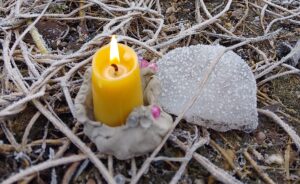
My personal practice is to rise with the sun and journal my dreams, my reflections on the past year and my intentions for the coming year. I find it anchors me amidst the busyness of extended family and friends time and feasting. This midwinter as I deep-cleaned my house ready for guests, gave clay to my child to make innumerable Divali candle holders, prepared for my ceremonies, feasted on numerous days with different family members, and celebrated the gradual lengthening of daylight, I felt a connection with my ancestors and siblings across the world, and a welling of peace and light inside me.
Whatever this time is for you, I hope that you have experienced some light within the darkness, some peace within the busyness, and have hope in your heart for the year to come.
In my work as a celebrant, I am passionate about finding the common threads between diverse world views and belief systems. We are all different, and that makes us fascinating, but as Jo Cox said, there is also more that is common about us than that which divides us.
If you are interested in any of the ceremonies and rituals mentioned here- parting ceremonies, appreciation rituals, hand-tying rituals, intercalary rituals, or if you have just got engaged and are thinking about your wedding ceremony, do get in touch or check out my ceremonies pages.